Travis McCoy–Max relationship
The Journey CollectionTravis McCoy–Max relationship is the central father–son bond through which Travis McCoy confronts the cost of choosing professional football over family. Max’s unexpected appearance at the Clarendon High School homecoming pep rally reveals that Travis is not merely returning to a town and a former love: he is encountering the ten-year-old son whose life he has missed. Their relationship then moves from biological discovery to deliberate fatherhood, as Travis learns that being Max’s father requires presence, reliability, and a permanent choice of home.
Identity and Discovery
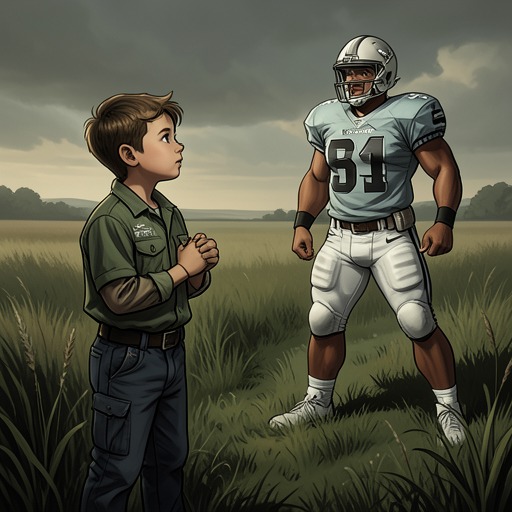
The relationship is established through a scene of immediate recognition and delayed understanding. At the pep rally, Travis agrees to sign a brown leather football for a boy who gives his name as Max. When Penelope Stone sees them together, her face twists in anguish; she rushes forward, embraces the child, and pulls him away. The boy’s embarrassed correction of her concern—calling her “Mom”—makes the family connection visible before Travis can understand it. Travis calculates that Max is at least ten years old and realizes that the child’s age corresponds to his own history with Penelope. The discovery turns his return to Clarendon into a confrontation with a hidden paternal identity.
Travis’s first response is not confident acceptance but stunned questioning. He asks Penelope what is happening and later insists on knowing whether Max is his son. His doubt wounds Penelope because it appears to question her honesty, while his anger reflects the violence of learning that an entire decade of fatherhood has passed without his knowledge. The conflict therefore contains two separate injuries: Travis has been denied the chance to know Max, and Max has grown up without Travis’s participation. The phrase “Our son” marks Travis’s first attempt to replace the language of suspicion with a claim of shared parenthood, even though that claim is initially unstable.
From Biological Fact to Social Fatherhood
The relationship changes when Max himself exposes that he already understands the truth. During a meal, Max asks when Travis planned to tell him that he is his dad, leaving Travis choking on his drink. Max explains that Penelope became emotional whenever the Miami Sharks played and that he had found photographs of Travis and Penelope in a box beneath her bed. He also recognizes that the chronology is obvious because he is already ten. Max has therefore assembled his own family history from fragments that the adults tried to keep separate from him.
Max does not respond with resentment. Instead, he tells Penelope that he is not angry and treats Travis’s presence as an opportunity for the family to become whole. When Max says that they can be a real family, Travis immediately promises that they can, even though Penelope’s glare shows that he is making a commitment before the adults have resolved their own history. Max’s acceptance gives the relationship an unusually direct emotional direction: the child does not ask Travis to prove his biological connection first; he asks him to participate.
That participation is tested when Stewart Thornton calls. As owner of the Miami Sharks, Stewart’s call may mean a trade or dismissal, and Travis has dreaded it for more than a month. The call instead presents the possibility of a coaching position after Travis’s shoulder injury ends his playing career. The professional offer would allow Travis to remain connected to the team, but Max hears the family’s future as a question of whether Travis will leave again. When Max asks if Travis is going to leave, the despair in his voice forces Travis to answer in personal rather than professional terms.
Promises, Attachment, and Conflict
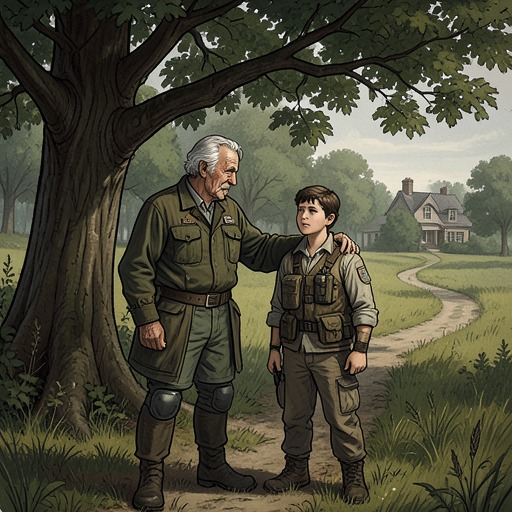
Travis tells Max that he will not leave. Max asks whether “home” means Travis, Penelope, and himself, and Travis answers that it does if they will have him. Max’s response is immediate and physical: he calls Travis “Dude,” embraces him, and says that he has been waiting for Travis to come home. The embrace gives concrete form to the relationship’s shift from revelation to attachment. Max is not simply accepting a newly identified father; he is making room for the father he has been missing.
The moment also contains a warning. Max tells Travis not to leave them again because they need him, then pulls back and observes that he hopes Travis’s word is worth something. His affection does not erase the history of abandonment; it makes reliability the condition of future trust. Travis answers that he needs Max too and promises not to leave him. The relationship consequently becomes reciprocal rather than charitable. Max needs a father, but Travis also needs Max as the person who makes a different future imaginable.
The emotional pattern is shaped by absence and return. Travis remembers that leaving Clarendon crushed Penelope, the one woman who had believed he could accomplish anything, and that the departure was the hardest moment of his life until the return journey. He reaches Clarendon after a delayed flight from Miami to Dallas, a hurried connection to Amarillo, persistent public attention from football admirers, and lost luggage that prolongs his arrival. These travel frustrations mirror the larger difficulty of coming back: physical arrival is easy compared with entering the life he abandoned. Max becomes the person who converts that abstract return into an obligation that must be honored daily.
Football, Home, and the Choice to Stay
Football first brings Travis and Max into the same space, but it eventually becomes the value against which Travis measures fatherhood. At the homecoming rally, Travis hears the band play the fight song and sees the packed gym, the maroon jerseys, school posters, cheering students, and the familiar ritual of Clarendon football. He has both hated and loved those Friday-afternoon ceremonies. Later, he leads the Clarendon Broncos onto the field, hears the crowd surround the players with communal approval, and tells the team that their hard work has earned the community’s respect. The scene reconnects Travis with football as a local inheritance rather than merely a professional spectacle.
That distinction matters to Max’s relationship with him. Travis has stood in immense stadiums before thousands of fans, but the feeling of being home with Penelope and Max exceeds those professional triumphs. The field remains meaningful, yet it no longer supplies the only definition of success. Travis’s identity moves from celebrated Miami Sharks player toward former player, possible coach, teacher, and father. The transition is not presented as simple loss: his football knowledge can still serve others, but his most consequential team is now the family waiting in Texas.
When Travis meets Stewart in Miami, Stewart acknowledges that Travis is finished as a player because his shoulder will never become strong enough for him to play again, but offers him the chance to coach. Travis explains that football has been his life since childhood and that he once slept with his football, making the sacrifice tangible rather than rhetorical. He also says that returning home helped him discover where his future lies: with his family in Texas, with people who love him and need him. His decision to decline the Sharks coaching offer is therefore inseparable from Max. Travis does not merely retire from an occupation; he refuses to let football remain the organizing center of a life in which his son has finally become present.
Change and Lasting Significance
Five months after finding Penelope and Max, Travis holds a small black velvet box and prepares to propose to Penelope. He understands the journey as painful because he has lost ten years of Max’s life while pursuing his dream of professional football, yet he now regards Penelope and Max as his future and his life. His planned marriage is not separate from fatherhood: it is another way of making the family structure he promised Max durable.
Travis’s declaration to Penelope that he has loved her since he was fourteen and that she has always owned his heart and soul echoes the language surrounding Max’s arrival. The earlier return exposed a family bond that had been interrupted; the proposal seeks to formalize the household in which that bond can continue. Later family developments, including Russ McCoy’s decision to propose to Nadine and Penelope’s labor when the baby is coming, place Max within a widening family network. The relationship with Travis is thus not frozen at the moment of discovery. It becomes part of an evolving family life marked by marriage, remarriage, and the arrival of another child.
The relationship’s decisive achievement is the conversion of fatherhood from a biological fact into a sustained practice. Travis cannot recover the ten years he missed, and Max’s guarded request that his word prove meaningful keeps that loss visible. Yet Travis answers the loss with presence: he returns to Clarendon, faces the consequences of his former departure, accepts Max’s embrace, leads the local team, and rejects a professional future that would take him away again. Max’s role is equally active. He recognizes the truth, offers Travis a place in the family, tests his promise, and gives the returning father a reason to choose permanence. Together, they redefine home not as the place Travis came from, nor as the stadium where he became famous, but as the relationship in which both father and son agree to remain.